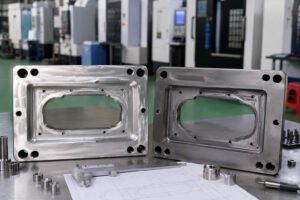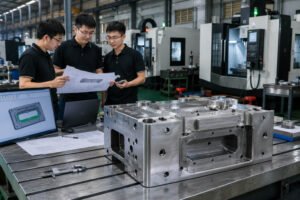
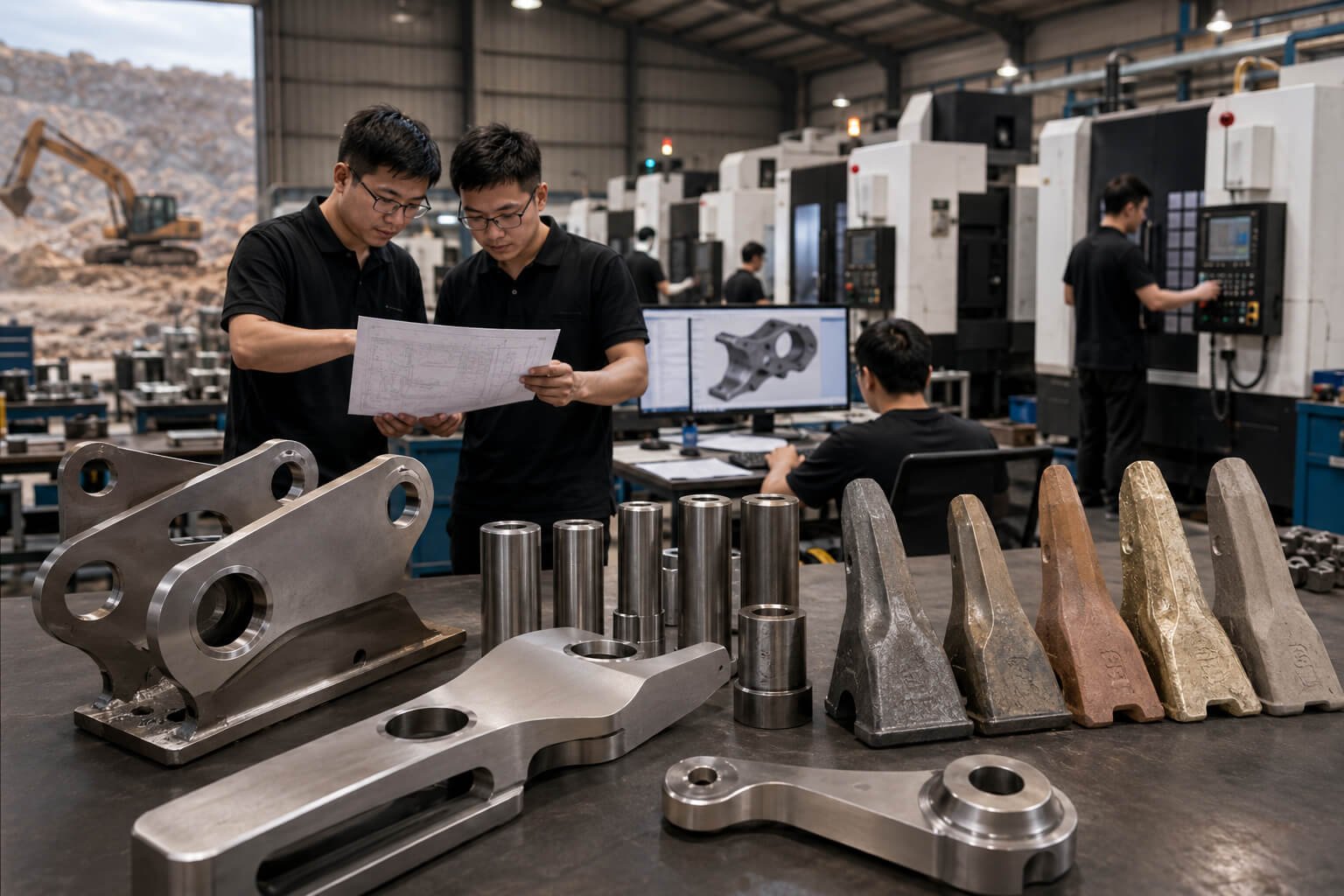
Custom excavator parts manufacturing combines material engineering, casting or forging, heat treatment, CNC machining, and dimensional control to produce components that must withstand heavy impact and repeated loads. Products such as quick coupler bodies, hinge pins, bucket teeth, and track links have different working conditions, so each requires a different manufacturing process and material strategy.
For B2B buyers, understanding these differences helps prevent one of the most common sourcing mistakes: evaluating heavy equipment components only by appearance and unit price.
Custom Excavator Parts Manufacturing: Different Parts Need Different Processes
An excavator contains many parts that operate under very different mechanical conditions.
A bucket tooth cuts into soil and rock.
A quick coupler body carries the load between the excavator and attachment.
A pin forms a rotating joint and experiences concentrated loading.
Track links support the machine and continuously transmit impact loads through the undercarriage.
Therefore, they should not all be manufactured using the same material or process.
A custom manufacturer must first understand the application and then determine the appropriate production route.
Typical manufacturing methods include:
- Precision casting
- Forging
- Heat treatment
- CNC turning
- CNC milling
- Five-axis machining
- Boring
- Drilling
- Grinding
- Induction hardening
- Assembly machining
This combination of processes allows the manufacturer to balance strength, wear resistance, accuracy, and production cost.
Excavator Quick Coupler Main Bodies
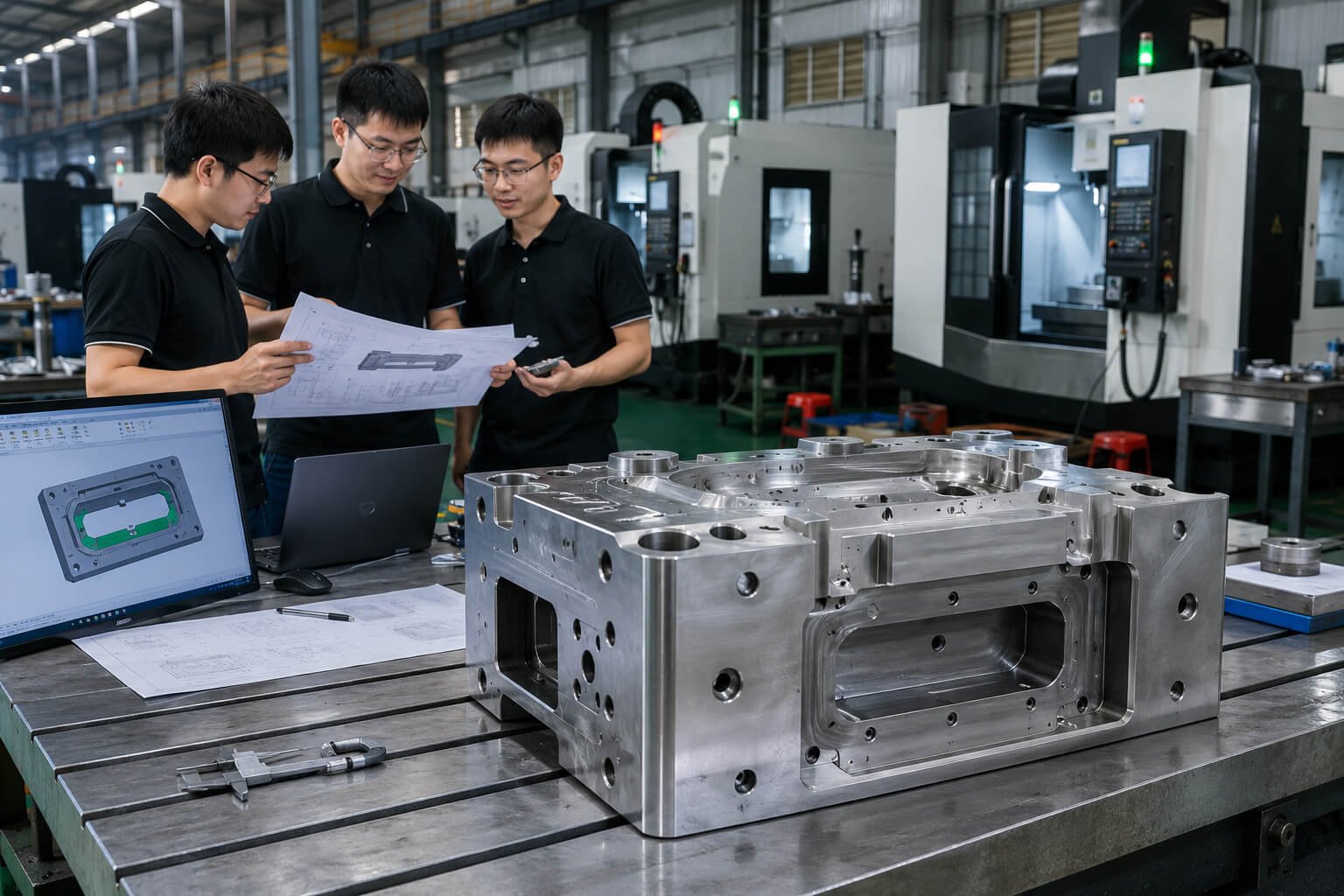
The quick coupler is a highly loaded connection system installed between the excavator arm and different attachments.
It allows operators to change:
- Buckets
- Hydraulic breakers
- Grapples
- Wood grabs
- Other work tools
The main coupler body acts as the structural foundation.
For customized quick coupler bodies, materials such as 42Cr or 42CrMo high-strength alloy structural steel can be used according to engineering requirements.
The manufacturing process can include:
- Cast or forged blank preparation
- Five-axis CNC precision milling
- Boring
- Drilling
- Chamfering
- Deburring
Precision is important because the coupler body must fit pins, cylinders, jaws, and other components correctly.
Incorrect hole spacing or poor coaxiality can cause assembly problems or abnormal loading.
For this reason, B2B buyers should provide complete drawings rather than only basic dimensions.
Quick Coupler Pins and Hinge Pins
Pins appear simple, but they are highly functional components.
A quick coupler hinge pin acts as a rotating connection between moving structures.
During operation, it may experience:
- Shear load
- Bending load
- Shock
- Sliding friction
- Repeated rotation
For custom coupler pins, 42CrMo alloy structural steel can be used.
A typical production sequence includes:
- Round bar cutting
- CNC turning
- Induction hardening
- Cylindrical grinding
- Grooving
- Drilling
Selected specifications can include:
| Parameter | Example Requirement |
|---|---|
| Material | 42CrMo |
| Heat treatment | Surface induction hardening |
| Surface hardness | HRC 52–58 |
| Outer diameter tolerance | ±0.015 mm |
| Surface roughness | Ra 0.8 |
| Additional features | Lubrication hole / groove |
The lubrication hole is a small feature with an important purpose.
It allows grease to reach the working interface, reducing wear between the pin and bushing.
Excavator Bucket Teeth
Bucket teeth work in a completely different environment.
They are directly exposed to abrasive materials such as:
- Soil
- Sand
- Gravel
- Rock
- Ore
- Demolition debris
Therefore, wear resistance and impact resistance are major priorities.
Bucket teeth can be produced from high-manganese alloy steel or wear-resistant cast steel, depending on the product design.
Typical processes include:
- Precision casting
- Quenching
- Tempering
Different tooth profiles are suitable for different conditions.
Common Bucket Tooth Types
| Tooth Type | Typical Application |
|---|---|
| General-purpose tooth | Earthmoving and general excavation |
| Rock tooth | Hard ground and rocky conditions |
| Sharp tooth | Penetration-focused digging |
| Heavy-duty tooth | High-impact applications |
For distributors and equipment parts wholesalers, identifying the target working environment is essential when selecting the right tooth design.
A visually similar tooth can perform very differently if the material or heat treatment does not match the application.
Excavator Track Links
Track links are core components of the undercarriage.
Multiple links are connected using pins and bushings to form the crawler chain.
During operation, the links carry:
- Machine weight
- Driving force
- Shock load
- Ground reaction
- Repeated articulation
This creates demanding strength and fatigue requirements.
Track links can be produced using alloy cast steel with processes such as:
- Lost foam casting or forging
- Heat treatment
- CNC hole machining
The working surfaces can receive hardening treatment to improve wear resistance.
Accurate pin and bushing holes are particularly important because they influence chain assembly and movement.
Poor hole alignment can accelerate wear and reduce undercarriage life.
Why Heat Treatment Is Critical
Heat treatment is not merely a finishing step.
It changes the internal mechanical properties of the steel.
Depending on the component, the purpose may be to improve:
- Surface hardness
- Wear resistance
- Core toughness
- Fatigue strength
- Impact resistance
Different excavator parts therefore require different strategies.
A bucket tooth needs wear and impact resistance.
A coupler pin may require a hard surface combined with a tougher core.
A track link needs enough strength and wear performance to operate under repeated undercarriage loading.
Applying maximum hardness to every component would not be good engineering.
Excessive hardness can reduce toughness and increase the risk of brittle failure.
The correct balance depends on part function.
CNC Machining for Heavy Equipment Components
Casting and forging create strong near-net-shape blanks, but many functional areas still require machining.
These may include:
- Pin holes
- Mounting holes
- Bearing surfaces
- Cylinder installation features
- Locating surfaces
- Threads
- Lubrication passages
CNC machining provides the dimensional consistency needed for assembly.
For complex coupler bodies, five-axis machining can reduce repeated repositioning and make complex features easier to produce accurately.
For long cylindrical components such as pins, CNC turning and grinding are more suitable.
A manufacturer with different machining platforms can assign each component to the correct equipment.
Liangde’s factory includes more than one hundred machining units, including CNC machining centers, vertical CNC lathes, CNC lathes, slant-bed lathes, Wire EDM machines, gantry machining centers, large horizontal machining centers, double-sided milling machines, and drilling equipment.
This equipment range is useful for non-standard heavy equipment parts because geometry varies significantly from one project to another.
Custom Parts Made According to Drawings
Many aftermarket and OEM excavator components are non-standard.
The manufacturer may need to work according to:
- Customer drawings
- Existing equipment models
- Physical samples
- Assembly dimensions
- Modified designs
Custom production can be especially useful for:
- Equipment manufacturers
- Attachment manufacturers
- Repair companies
- Mining equipment suppliers
- Aftermarket distributors
- Heavy machinery wholesalers
For quick couplers, customers may require different dimensions for different excavator tonnages.
For pins, diameter, length, groove position, lubrication structure, and hardness can all be customized.
For tooling and forming projects, left/right matching parts may also be required.
What B2B Buyers Should Check Before Ordering
Overseas procurement teams should evaluate more than the quotation.
Before selecting a supplier, check the following areas:
- Does the manufacturer understand the actual application?
- Is the material specification clear?
- Is the heat treatment process defined?
- Are critical dimensions identified?
- Can the supplier machine complex parts internally?
- Are custom drawings supported?
- Can left/right or matched parts be controlled?
- Are parts marked for traceability where required?
- Can technical changes be communicated with engineers?
For engineered components, a slightly lower initial price can become expensive if the part requires rework after arrival.
Engineering communication is therefore part of the product value.
How to Prepare an Effective RFQ
A complete RFQ can shorten the quotation process considerably.
Buyers should provide:
Drawing Information
- 2D PDF or DWG
- STEP / IGES / other 3D file
- Critical dimensions
- Tolerances
Material Information
- Required steel grade
- Alternative material policy
- Required certification if applicable
Heat Treatment
- Hardness
- Hardening depth if relevant
- Quenching/tempering requirement
Commercial Information
- Prototype quantity
- Annual demand
- Batch quantity
- Delivery destination
Application Information
Explain where the component is used.
This helps the engineering team understand why certain dimensions or mechanical properties are important.
OEM and Non-Standard Manufacturing
Custom manufacturing is particularly valuable when the buyer cannot use a standard catalog component.
Examples include:
- Proprietary quick coupler structures
- Special attachment interfaces
- Custom hinge pins
- Replacement parts for older machinery
- Modified wear parts
- New undercarriage components
A manufacturing partner with 3D modeling and reverse engineering capability can also support projects where complete design data is not available.
Reverse modeling can convert sample geometry into digital data for further engineering evaluation.
This can be useful when replacing discontinued or difficult-to-source components.
Frequently Asked Questions
What materials are commonly used for excavator quick coupler bodies?
High-strength alloy structural steels such as 42Cr or 42CrMo may be used depending on the design, working load, heat treatment requirement, and customer specification.
Why is 42CrMo commonly used for excavator pins?
42CrMo offers a useful combination of strength, toughness, and heat-treatment response. Its surface can be hardened while maintaining suitable core properties for heavily loaded hinge and connection applications.
What hardness can quick coupler pins achieve?
For selected custom pins, surface hardness after induction hardening can be approximately HRC 52–58. The exact requirement should follow the engineering drawing and operating conditions.
Can excavator parts be manufactured according to customer drawings?
Yes. Quick coupler bodies, pins, track components, tooling parts, and other non-standard components can be manufactured according to customer-provided 2D and 3D drawings.
Are bucket teeth available for different excavation conditions?
Yes. Different designs may be optimized for general earthmoving, rock excavation, penetration, mining, or heavy-duty use. Material and heat treatment should also match the intended working environment.
What information is needed for a custom excavator part quotation?
Provide drawings, material grade, heat treatment, critical tolerances, quantity, excavator model or application, and required delivery information. Detailed RFQs normally receive more accurate engineering evaluations.
Conclusion
Successful custom excavator parts manufacturing depends on matching the material and production process to the actual working condition.
Quick coupler bodies require structural strength and accurate machining. Pins need strong load-bearing capability, wear-resistant surfaces, and precision grinding. Bucket teeth require wear and impact resistance. Track links must withstand continuous machine weight and undercarriage shock.
For B2B buyers, the strongest sourcing strategy is to work with a manufacturer that combines forging or casting knowledge, CNC machining, heat treatment understanding, 3D engineering, and non-standard customization.
Send your CAD drawings, material specifications, required quantity, and application details to Liangde’s engineering team for a customized manufacturing quotation.