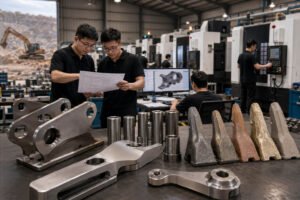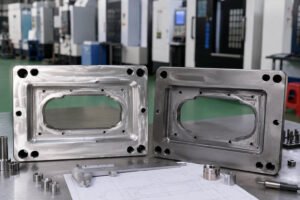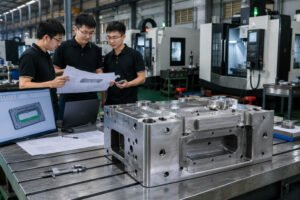
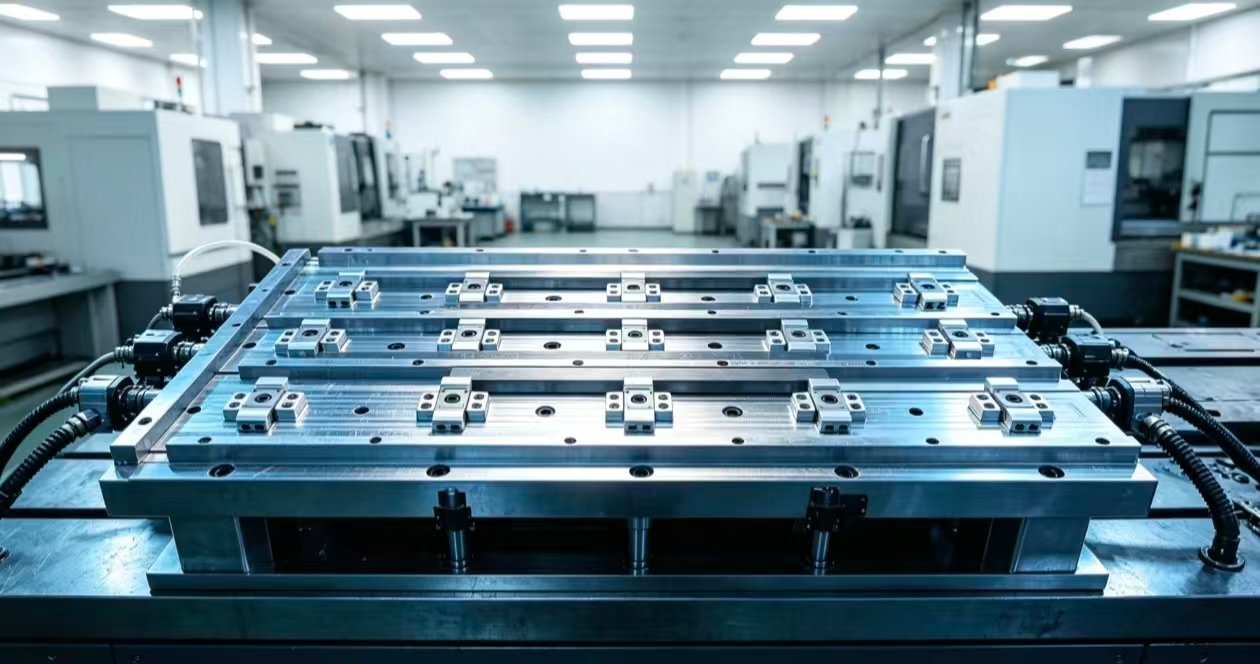
 In modern CNC machining workshops, workholding efficiency directly determines machine utilization rate, processing accuracy, and mass production capacity. Every minute spent on clamping, positioning, and recalibration is a minute the spindle is not cutting. For factories running batch orders, the cost of inefficient workholding accumulates rapidly — in labor hours, in scrapped parts, and in missed delivery deadlines.
Traditional clamping methods such as standard vises, single-point pressing plates, and custom welded fixtures often suffer from limited stations, unstable clamping force, and time-consuming setup. A standard machine vise can hold only one or two workpieces at a time, and each changeover requires re-zeroing, re-indicating, and re-testing. For small to medium batch production, this auxiliary time can easily exceed the actual cutting time.
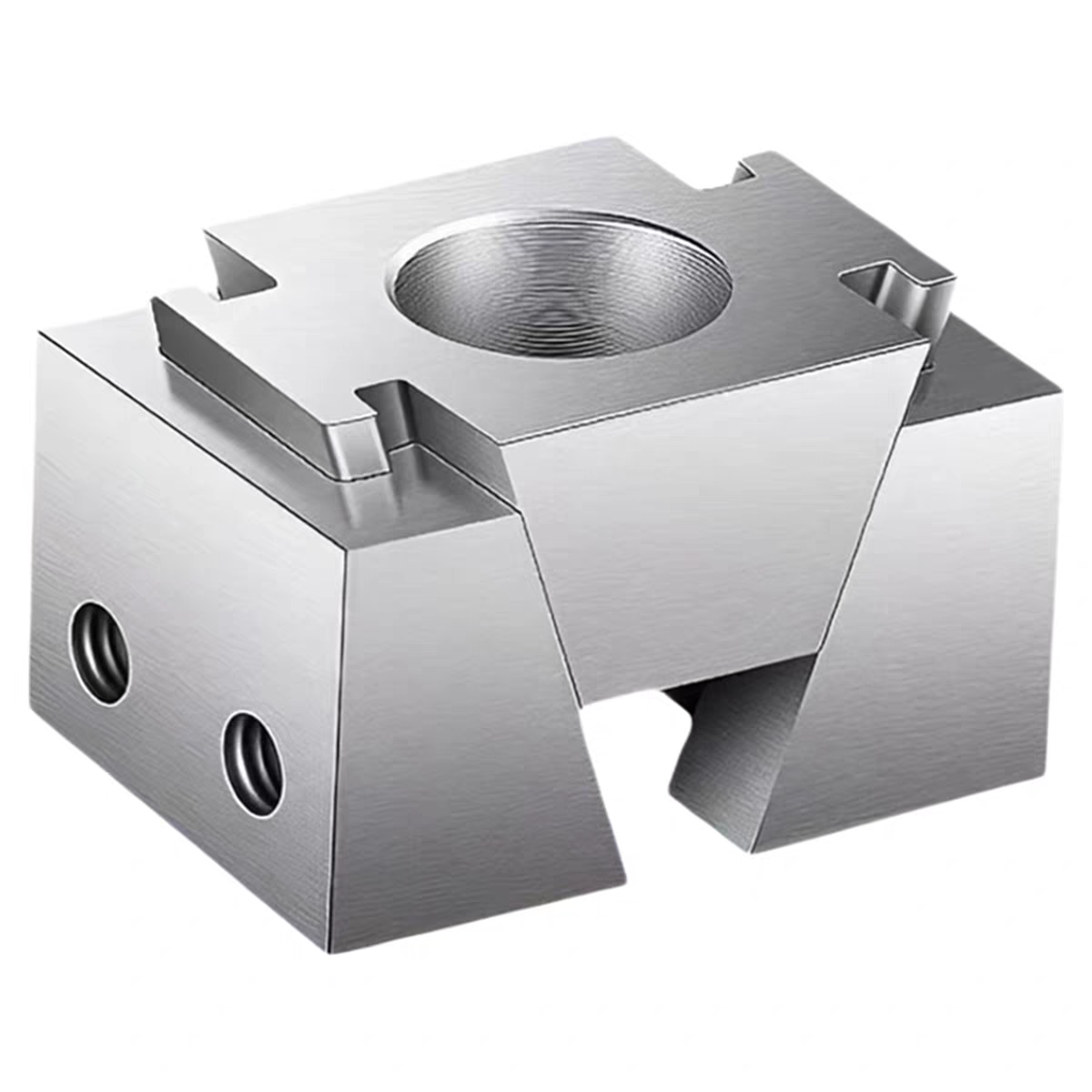
As a high-efficiency modular workholding tool, OK Fixture (OK Clamp) has become the standard solution for multi-station batch machining. Its unique wedge self-locking structure allows multiple workpieces to be clamped in one single setup, greatly reducing tool change time and improving overall production efficiency. Unlike traditional vertical compression clamps that risk lifting the workpiece off the datum surface, OK Fixture delivers pure horizontal parallel clamping force that keeps the workpiece firmly seated against the base plate throughout the entire cutting cycle.
This article provides a comprehensive technical guide to OK Fixture — covering its working principle, material and manufacturing process, selection criteria, installation and operation, maintenance, application scenarios, and frequently asked questions — to help machining engineers and procurement teams make informed decisions.
How Does an OK Fixture Work?
The working principle of the OK fixture relies on wedge parallel self-locking mechanics, which is fundamentally different from traditional vertical compression fixtures. Understanding this mechanism is essential for maximizing its performance and avoiding common misuse.
Clamping Cycle
When the top screw (Part A) moves downward, the internal wedge structure converts the vertical force into horizontal outward thrust. This thrust pushes the two side clamping blocks (Part B & C) to expand outward in parallel and cling tightly to the base plate. The clamping blocks slide along precision-ground guide surfaces, ensuring that the movement is purely horizontal with zero vertical displacement.
This horizontal expansion provides uniform clamping force across the contact surface, locking the workpiece firmly in position. Because the force is applied horizontally rather than vertically, the workpiece is pressed against the side datum while remaining fully seated on the base plate — eliminating the micro-lifting problem that plagues traditional clamp designs.
Release Cycle
When releasing, lifting the top screw (Part A) removes the wedge pressure. The built-in stainless steel spring then retracts the side blocks (Part B & C) inward in parallel. A critical design feature here is that the clamping blocks only move horizontally along the base — they do not rise together with the top screw. This is achieved through the spring-loaded retraction mechanism combined with the guide rail geometry.
This parallel retraction ensures zero displacement error and perfect repeat positioning. When the operator clamps the same workpiece again, the blocks return to exactly the same position, guaranteeing consistent locating accuracy batch after batch.
Self-Locking Feature
The wedge angle is carefully calculated to provide self-locking behavior. Once clamped, the wedge mechanism holds its position mechanically — even if the screw experiences slight vibration loosening during heavy cutting. This self-locking characteristic is particularly valuable for high-vibration operations such as rough milling, interrupted cuts, and heavy drilling.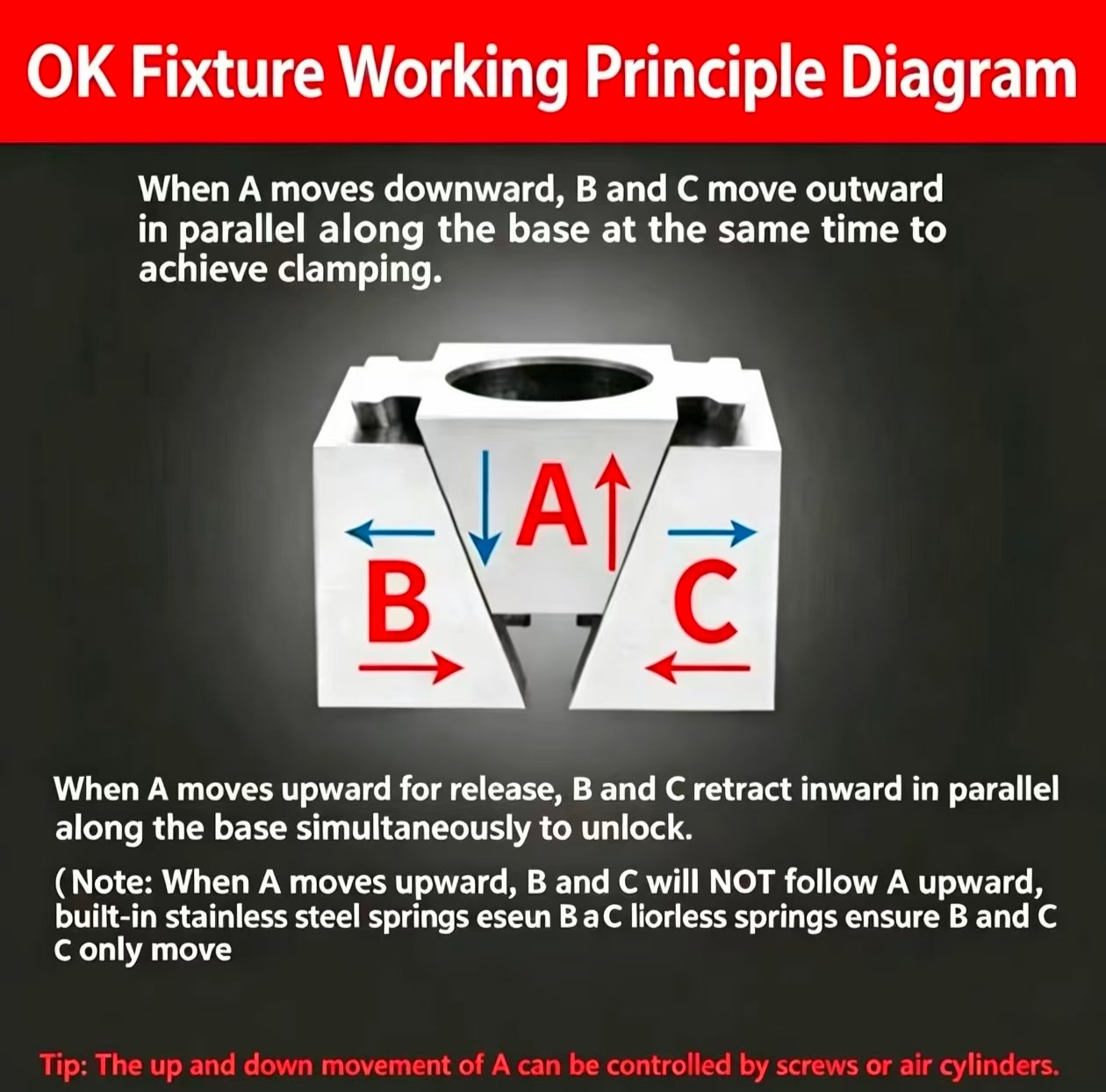
Core Advantages of OK Fixture in CNC Machining
1. Anti-Lifting & Ultra-Stable Clamping
Most traditional clamps generate vertical pressure that easily causes workpiece micro-lifting during high-speed milling and heavy cutting. Even a lift of 0.01 mm can result in out-of-tolerance dimensions, poor surface finish, or scrapped parts. OK Fixture adopts horizontal parallel clamping force, which keeps the workpiece fully attached to the base plate. No floating, no shaking, ensuring consistent dimensional tolerance for batch parts.
This anti-lifting performance is especially critical when machining thin or flexible workpieces, where vertical clamping force would cause warping or spring-back.
2. Multi-Station Combination & High Efficiency
OK Fixture features a highly modular design. Multiple clamps can be freely arranged and combined on the fixture plate to realize 4-station, 6-station, 8-station, 12-station or even more multi-workpiece clamping. The compact body design allows dense packing of stations — far more workpieces per machine table than a standard vise arrangement.
One machine run can complete multiple parts processing, drastically improving CNC machine utilization. For a typical 8-hour shift, a multi-station OK Fixture setup can produce 3–5 times more parts than a single-station vise, depending on cycle time and part size.
3. Save Massive Setup Time
Traditional single-piece clamping requires repeated positioning, locking, and calibration. With OK Fixture multi-station layout, workers only need one-time alignment for the entire fixture plate. Once the plate is indicated and locked, every station on it is automatically aligned to the machine coordinate system. This reduces clamping frequency and shortens auxiliary time by more than 50% in mass production.
For repeat orders, the entire fixture plate can be stored and remounted without re-indicating — the clamps hold their calibration, and the operator simply loads the plate, confirms the zero point, and starts cutting.
4. High Hardness & Long Service Life
The body of our OK Fixture is made of high-strength alloy steel, processed through precision CNC machining and strict heat treatment. The surface adopts nitriding hardening treatment, featuring high hardness (typically HRC 58–62 on working surfaces), strong wear resistance, and deformation resistance under long-term heavy load cutting.
The internal wedge and guide surfaces are precision ground to ensure smooth sliding action and minimal wear over tens of thousands of clamping cycles. The stainless steel springs are selected for fatigue resistance, maintaining consistent retraction force even after repeated daily use over several years.
5. Wide Compatibility
OK Fixture is suitable for standard fixture plates, T-slot worktables of machining centers, milling machines, and drilling machines. It can be flexibly matched with stoppers, positioning blocks, heightening blocks, and custom sub-plates to adapt to different sizes of mold parts, mechanical accessories, and automotive precision parts.
The clamps can be mounted directly on T-slot tables using standard T-bolts, or integrated into dedicated fixture pallets for quick-change systems. This compatibility makes OK Fixture a versatile investment that can be redeployed across different machines and job types.
Material & Manufacturing Process
The performance and durability of an OK Fixture depend heavily on the quality of its materials and the precision of its manufacturing process. Below is a detailed breakdown of the production workflow.
Material Selection
表格
| Component | Material | Treatment | Purpose |
|---|---|---|---|
| Main body | 42CrMo / 40Cr alloy steel | Quenched & tempered + nitriding | High strength, wear resistance, anti-deformation |
| Wedge (Part A) | Cr12MoV / DC53 die steel | Vacuum quenching + tempering | High hardness, impact resistance, long sliding life |
| Clamping blocks (B & C) | 42CrMo alloy steel | Carburizing or nitriding | Wear-resistant contact surface, tough core |
| Retraction spring | 304 / 316 stainless steel | Spring tempering | Corrosion resistance, fatigue resistance |
| Fasteners | 12.9 grade alloy steel | Black oxide | High tensile strength, reliable clamping |
Manufacturing Steps
- Raw material preparation — Cut alloy steel bar or plate to rough dimensions, with sufficient machining allowance.
- Rough machining — CNC milling and drilling to remove excess material, forming the basic body shape and internal cavities.
- Heat treatment — Quenching and tempering to achieve core hardness of HRC 28–32, providing a balance of strength and toughness.
- Semi-finishing — CNC machining to near-final dimensions, leaving grinding allowance of 0.2–0.3 mm on critical surfaces.
- Surface hardening — Nitriding treatment on working surfaces to achieve surface hardness of HRC 58–62 with a hardened layer depth of 0.3–0.5 mm.
- Precision grinding — Surface grinding and jig grinding on wedge surfaces, guide rails, and datum faces to ensure flatness within 0.005 mm and parallelism within 0.008 mm.
- Assembly & testing — Assemble all components, test clamping and release action for smoothness, verify clamping force, and conduct repeatability testing.
- Final inspection — Dimension inspection, hardness testing, surface quality check, and clamping force verification before packaging
Traditional Vise vs OK Fixture: Detailed Comparison
表格
Comparison Item Standard Machine Vise OK Fixture Stations per setup 1–2 4–12+ (modular) Clamping direction Vertical + horizontal Pure horizontal parallel Anti-lifting performance Weak (risk of workpiece lift) Excellent (zero vertical displacement) Setup time per batch Long (re-zero each change) Short (one-time plate alignment) Floor space per workpiece Large Compact (dense layout) Clamping force consistency Varies by operator Consistent (mechanical wedge) Suitable for irregular parts Limited Good (with auxiliary locators) Repeatability Moderate High (precision ground guides) Maintenance frequency Frequent (jaws wear, screw wear) Low (nitrided surfaces, sealed design) Best for Single-piece, large parts Batch, small-medium parts For factories pursuing standardized processing and automated production, OK Fixture is an essential upgrade tool to replace traditional single-station clamping. The initial investment is typically recovered within a few months through reduced labor cost and increased machine output.
How to Select the Right OK Fixture
Choosing the correct OK Fixture model and configuration requires consideration of several factors:
1. Workpiece Size and Weight
- Small parts (under 100 mm): Compact OK Fixture models, dense multi-station layout (8–16 stations).
- Medium parts (100–300 mm): Standard OK Fixture models, 4–8 stations.
- Large parts (over 300 mm): Heavy-duty OK Fixture or combination with auxiliary support blocks.
2. Cutting Load
- Light finishing (aluminum, small cuts): Standard clamping force models.
- Medium machining (steel, normal milling): Reinforced models with larger wedge area.
- Heavy roughing (hardened steel, deep cuts, interrupted cuts): Heavy-duty models with maximum clamping force and additional side support.
3. Machine Table Type
- T-slot table: Direct mounting with T-bolts, most flexible.
- Grid hole table (M8/M10/M12 threaded): Mounting via socket head cap screws, faster changeover.
- Zero-point quick-change system: Integrate OK Fixture onto zero-point pallets for ultimate efficiency.
4. Tolerance Requirements
- General tolerance (±0.05 mm): Standard OK Fixture.
- High precision (±0.01 mm): Precision-ground OK Fixture with matched locating pins.
- Ultra-high precision (±0.005 mm): Custom OK Fixture with in-process measurement and compensation.
5. Batch Size and Frequency
- Prototype / small batch (1–50 pcs): Basic OK Fixture set, flexible arrangement.
- Medium batch (50–500 pcs): Dedicated fixture plate with fixed station layout.
- Mass production (500+ pcs): Automated loading-compatible OK Fixture with pneumatic or hydraulic actuation.
Installation & Operation Guide
Installation Steps
- Clean the machine table — Remove all chips, coolant residue, and burrs from the T-slot or mounting surface.
- Position the fixture plate — Place the OK Fixture plate on the machine table, roughly aligned with the X and Y axes.
- Indicate the datum edge — Use a dial indicator to align the fixture plate’s reference edge parallel to the X-axis (or Y-axis, depending on orientation). Adjust until the reading variation is within 0.005 mm across the full length.
- Secure the plate — Tighten mounting bolts in a crisscross pattern to ensure even pressure. Re-check alignment after tightening.
- Set workpiece zero — Use an edge finder or probe to set the G54 (or selected) work coordinate zero at the designated datum point on the fixture plate.
- Test clamp action — Manually actuate each OK Fixture station to confirm smooth clamping and release. Check that all clamping blocks move in parallel without binding.
- Run a test cut — Machine a test workpiece or witness cut to verify positioning accuracy, clamping stability, and surface finish before running production.
Operation Best Practices
Proper maintenance extends the service life of OK Fixture and ensures consistent performance:
Daily Maintenance
- Clean all chips and coolant from the fixture after each shift using compressed air or a brush.
- Wipe the clamping surfaces and guide rails with a clean cloth.
- Apply a light film of rust-preventive oil if the fixture will be idle for more than one day.
Weekly Maintenance
- Inspect all clamping blocks for signs of wear, galling, or damage.
- Check that retraction springs return the blocks fully and smoothly.
- Verify that all mounting bolts remain tight.
- Clean and lubricate the wedge sliding surfaces with a light machine oil or dry film lubricant.
Monthly Maintenance
- Disassemble one representative OK Fixture unit for thorough inspection of internal components.
- Clean all parts in a solvent tank, removing accumulated grease, chips, and coolant residue.
- Inspect wedge surfaces for wear patterns — uniform polishing is normal; deep grooves or scoring indicate a problem.
- Check spring free length and replace if shortened by more than 5% (fatigue indicator).
- Reassemble with fresh lubricant and test clamping force.
Annual Maintenance
- Perform a full dimensional inspection of all critical surfaces (datum faces, guide rails, clamping faces).
- Re-grind or replace any components that exceed wear tolerances.
- Calibrate clamping force using a force gauge or pressure-sensitive film.
- Update maintenance records and plan replacement parts inventory.
Common Troubleshooting
表格
Problem Possible Cause Solution Clamping blocks do not retract fully Weak spring, debris in guide, bent block Clean guide rails, replace spring, inspect block Uneven clamping force Wedge surface wear, misaligned guide, workpiece not seated Re-grind wedge, realign, clean datum surfaces Workpiece shifts during cutting Insufficient torque, oily contact surface, excessive cut Increase torque, clean surfaces, reduce cut depth Clamping screw hard to turn Lack of lubrication, debris in threads, over-tightened Lubricate, clean threads, use correct torque Clamping marks on workpiece No contact pad, excessive force, sharp block edge Add brass/nylon pad, reduce torque, radius block edge Common Application Scenarios of OK Fixture
1. Mold Accessories Batch Processing
Mold bases, mold plates, ejector pins, guide bushes, and other standard mold components are ideal candidates for OK Fixture multi-station machining. These parts are typically produced in medium to large batches with consistent geometry, making the dense station layout highly efficient. The anti-lifting feature ensures that mold plates remain flat during face milling and pocketing operations.
2. Automotive Precision Parts Milling
Automotive components such as bracket parts, connector housings, valve bodies, transmission components, and brake system parts require high precision and consistent quality. OK Fixture provides the repeatability needed for automotive tolerances, while the multi-station layout supports the high-volume production demands of the automotive supply chain. The self-locking wedge mechanism is particularly valuable for automated loading cells where consistent clamping force is critical.
3. Hardware Mechanical Parts Mass Production
Screws, nuts, fittings, flanges, couplings, and other hardware items are often produced in very large quantities. OK Fixture can be configured with 8–16 stations per plate, and multiple plates can be swapped in sequence to create a continuous production flow. The low per-piece setup cost makes OK Fixture economically viable even for relatively low-value hardware parts.
4. Small and Medium-Sized Irregular Workpiece Clamping
Many machined parts do not have convenient parallel jaws for vise clamping — castings, forgings, welded assemblies, and custom fabrications often have irregular outer profiles. OK Fixture, combined with auxiliary positioning blocks, custom locators, and support pins, can stably clamp square, rectangular, and special-shaped small and medium-sized workpieces with high adaptability. The modular nature allows custom locating schemes to be built quickly without fabricating dedicated welded fixtures.
5. Long-Term Repeated Processing Orders
For factories that run the same parts on a recurring basis (e.g., annual supply contracts, spare parts production), OK Fixture offers significant long-term value. Once a fixture plate is configured and calibrated for a specific part, it can be stored on a shelf and remounted in minutes — no re-indicating, no re-tooling, no first-article scrap. This repeat-order efficiency compounds over the lifetime of the product.
6. 3-Axis and 4-Axis Machining Center Multi-Station Production
OK Fixture is compatible with both 3-axis and 4-axis machining centers. On 3-axis machines, the flat fixture plate maximizes the number of stations within the work envelope. On 4-axis machines with a rotary table, OK Fixture can be mounted on custom tombstones or angle plates, allowing multi-sided machining of workpieces in a single setup. This is especially valuable for parts that require machining on multiple faces — the workpiece is clamped once and indexed to each side without re-fixturing.
7. Pneumatic / Hydraulic Automated Loading
For high-volume automated production, OK Fixture can be adapted for pneumatic or hydraulic actuation. Instead of manually turning the top screw, an air cylinder or hydraulic cylinder drives the wedge mechanism up and down. This allows robotic loading systems to place workpieces, signal the fixture to clamp, and start the machining cycle — all without human intervention. Automated OK Fixture cells can run 24/7 with minimal operator supervision.
Quality Standard & Inspection
Our OK Fixtures are fully produced by precision CNC machining in our own factory. Every product goes through strict procedures including roughing, finishing, heat treatment, surface hardening, and flatness calibration.
All key contact surfaces maintain high flatness (≤0.005 mm) and parallelism (≤0.008 mm). The internal spring structure is made of imported stainless steel to ensure stable elasticity after long-term repeated use, avoiding clamping failure and position deviation.
Each OK Fixture unit undergoes the following quality checks before shipment:
- Dimensional inspection — All critical dimensions verified against engineering drawings using CMM (Coordinate Measuring Machine) and calibrated gauges.
- Hardness testing — Surface hardness verified on nitrided surfaces using a Rockwell hardness tester.
- Clamping force test — Actual clamping force measured using a force gauge to ensure it meets or exceeds the rated specification.
- Repeatability test — 50 consecutive clamp-release cycles with measurement of workpiece position variation (must be ≤0.005 mm).
- Smooth action test — Manual operation of clamping and release to confirm no binding, no excessive force required, and full retraction.
- Surface finish inspection — Visual and tactile inspection for burrs, sharp edges, corrosion, or surface defects.
FAQ About OK Fixture
Q1: Can OK Fixture prevent workpiece lifting during heavy cutting?
A: Yes. Different from vertical compression clamps, OK Fixture provides pure horizontal parallel clamping force. The workpiece is always pressed close to the base plate, effectively eliminating lifting and vibration during heavy cutting. This is the core design advantage of the wedge parallel mechanism.
Q2: How many stations can one workpiece plate arrange?
A: It depends on workpiece size and the machine table dimensions. Small parts (under 50 mm) can realize 12–16 stations in a dense layout; medium parts (50–150 mm) typically allow 6–8 stations; larger parts (150–300 mm) usually accommodate 2–4 stations. The key is to leave adequate clearance for tool access and chip evacuation.
Q3: Is OK Fixture reusable for long-term batch orders?
A: Absolutely. With alloy steel body and nitriding surface treatment, it has excellent wear resistance and fatigue resistance, suitable for long-term repeated fixture use. A well-maintained OK Fixture can provide 5–10 years of reliable service, even with daily use in production environments.
Q4: Can OK Fixture clamp irregular workpieces?
A: Yes. Combined with auxiliary positioning blocks, custom locators, support pins, and step blocks, it can stably clamp square, rectangular, and special-shaped small and medium-sized workpieces with high adaptability. For highly complex geometries, we can design custom locating components that integrate with the standard OK Fixture body.
Q5: What is the maximum clamping force of OK Fixture?
A: Clamping force varies by model size. Standard models typically provide 15–30 kN of clamping force per station; heavy-duty models can provide 40–60 kN. The actual force also depends on the torque applied to the clamping screw. We provide torque specifications for each model to help operators achieve consistent, safe clamping force.
Q6: Can OK Fixture be used on a 4-axis machine with a rotary table?
A: Yes. OK Fixture can be mounted on custom tombstones, angle plates, or rotary table fixtures for 4-axis machining. This allows multi-sided machining in a single setup, reducing the number of operations and improving accuracy. We can provide custom mounting solutions for specific 4-axis configurations.
Q7: Is pneumatic or hydraulic actuation available?
A: Yes. For automated production cells, OK Fixture can be equipped with pneumatic or hydraulic cylinders to drive the wedge mechanism. This enables robotic loading and unmanned operation. The actuation system can be integrated with the machine’s M-code or a separate PLC for automatic clamp/release sequencing.
Q8: How do I choose between OK Fixture and a standard vise?
A: The decision depends on your production profile:
- Choose standard vise if you produce mostly single-piece or very small batch parts, especially large parts that require full jaw contact.
- Choose OK Fixture if you run medium to large batches, need multi-station efficiency, struggle with workpiece lifting, or want to reduce setup time for repeat orders.
- Many factories use both — vises for large/one-off parts and OK Fixture for batch production of smaller components.
Q9: What is the lead time for custom OK Fixture solutions?
A: Standard OK Fixture models are typically in stock and can ship within 3–5 working days. Custom configurations (special sizes, custom locators, pneumatic/hydraulic actuation, 4-axis tombstones) generally require 15–25 working days, depending on complexity. We provide detailed drawings and quotations within 2–3 working days of receiving your requirements.
Q10: Can OK Fixture be used for grinding or EDM operations?
A: OK Fixture is primarily designed for milling, drilling, and tapping operations on machining centers. For grinding, the clamping force and precision are generally sufficient, but coolant and abrasive slurry may accelerate wear on sliding surfaces — extra sealing and more frequent cleaning are recommended. For EDM (wire or sinker), the metallic fixture body may interfere with the dielectric process; in such cases, we recommend custom non-conductive locator components or alternative fixturing methods.
Conclusion
OK Fixture has redefined high-efficiency CNC workholding. With its unique wedge parallel self-locking principle, anti-lifting performance, modular multi-station design, and durable quality, it solves the pain points of low efficiency and unstable precision in traditional clamping methods.
For CNC machining workshops focusing on batch production, standardized processing, and stable product quality, OK Fixture is one of the most cost-effective and essential workholding tools available. The return on investment is measurable — in reduced labor hours, in increased machine output, in fewer scrapped parts, and in shorter lead times for customers.
Beyond the standard product, the true value of OK Fixture lies in its adaptability. Whether you need a simple 4-station plate for mold components, a fully automated pneumatic cell for automotive parts, or a custom 4-axis tombstone for complex multi-sided machining, OK Fixture can be configured to meet your specific requirements.
We support wholesale, OEM, and customized specification OK Fixtures. Our engineering team can work with your part drawings, machine specifications, and production volume to design the optimal fixturing solution. Welcome to contact us for factory direct price, technical consultation, and custom solution support.