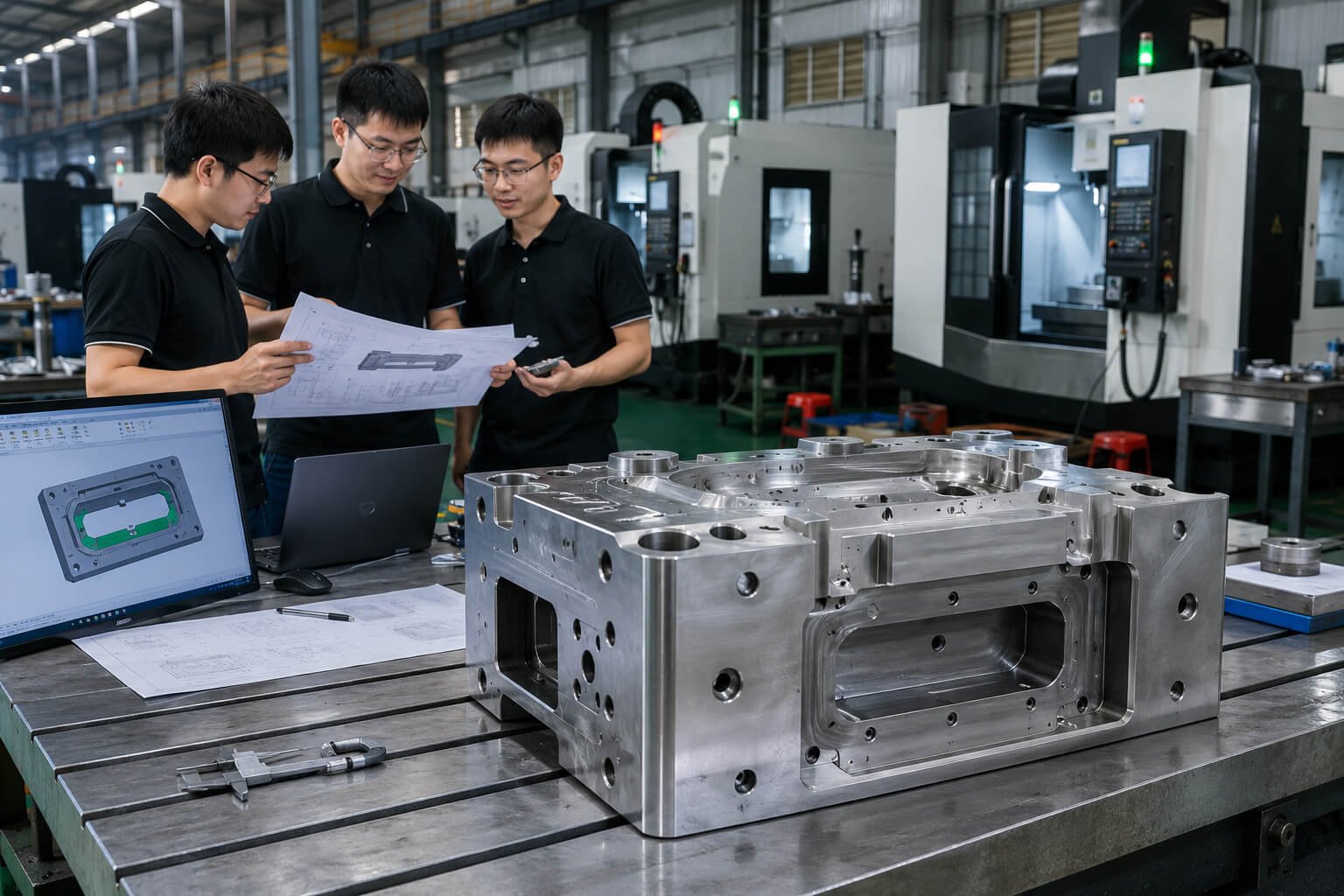
A reliable custom forging die manufacturer should do more than simply machine steel according to a drawing. The right supplier needs to understand forging flow, die structure, material selection, machining accuracy, production equipment, and how the die will behave during actual forging. For B2B buyers, evaluating these capabilities before placing an order can greatly reduce tooling modifications, production delays, and unnecessary costs.
Forging dies are critical production tools. Their quality directly affects dimensional consistency, surface condition, material utilization, productivity, and the service life of the entire forging process.
For companies purchasing custom dies, the challenge is often not finding a factory that owns CNC machines. The real challenge is finding a supplier that understands both tool manufacturing and the forging process itself.
Custom Forging Die Manufacturer: What Should Buyers Evaluate?
When evaluating a forging tooling supplier, buyers should focus on engineering capability first.
A professional supplier normally needs to support several stages of the project:
- Product drawing analysis
- 3D modeling
- Reverse engineering when required
- Forging die structure design
- Tool motion simulation
- Metal flow analysis
- Raw material selection
- CNC machining
- Wire EDM
- Drilling and milling
- Assembly and fitting
- Final inspection
A supplier that controls more of these processes internally can usually respond faster when design changes are required.
For custom projects, this is especially important because forging tooling rarely works as a completely independent component. The die must match the forging machine, billet dimensions, forming sequence, material characteristics, and required final geometry.
Engineering and Forging Design Experience
One of the first questions a buyer should ask is simple:
Does the manufacturer understand forging, or only machining?
There is a major difference.
A machining company can manufacture a block according to a CAD file. A forging-focused tooling manufacturer should also understand how the metal moves inside the cavity during deformation.
This knowledge helps the engineering team evaluate:
- Material filling behavior
- Flash formation
- Draft angles
- Forming pressure
- Die loading
- Potential underfill areas
- Excessive material concentration
- Tool wear locations
- Possible cracking or folding risks
For complex forged components, engineering decisions made before machining often determine whether the die can enter production smoothly.
Liangde’s manufacturing background includes approximately 30 years of experience in the forging industry. Its engineering capabilities include professional 3D modeling, reverse modeling, die design, motion simulation, and finite element simulation of forging metal flow.
For an overseas buyer, this type of capability matters because it can help identify potential problems before steel is machined.
3D Modeling and Metal Flow Simulation
Modern forging die development should increasingly rely on digital engineering.
A well-designed 3D model allows engineers to evaluate the relationship between:
- Upper and lower dies
- Inserts
- Guide structures
- Workpiece geometry
- Equipment movement
- Tool clearance
- Positioning components
For more complex forging processes, finite element simulation can provide additional insight.
Metal flow simulation helps engineers predict how heated metal will move under forming pressure.
This can be useful for reducing:
- Incomplete filling
- Unstable forging flow
- Material waste
- Localized excessive stress
- Premature tool wear
- Repeated trial-and-error modification
Simulation does not eliminate the need for practical forging experience. Instead, the two should work together.
Experienced engineers understand which simulation results deserve attention and how real production conditions may differ from the theoretical model.
Digital Engineering Capability Comparison
| Capability | Basic Machining Supplier | Professional Forging Die Manufacturer |
|---|---|---|
| 2D drawing machining | Yes | Yes |
| 3D modeling | Sometimes | Yes |
| Reverse engineering | Limited | Available |
| Die motion simulation | Rare | Available |
| Metal flow simulation | Rare | Available |
| Forging process understanding | Limited | Strong |
| Production line planning | Usually no | Possible |
For buyers developing new forged products, the second type of supplier normally provides more engineering value.
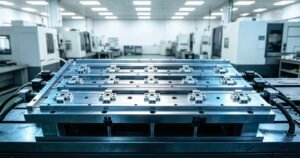
Machining Equipment and Production Capacity
The quality of forging tooling depends heavily on machining capability.
Different die structures require different machine configurations. One CNC machining center cannot efficiently handle every geometry.
A capable tooling factory may require access to:
- Vertical CNC machining centers
- Horizontal machining centers
- Large machining centers
- CNC vertical lathes
- CNC lathes
- Slant-bed lathes
- Gantry machining centers
- Double-sided milling machines
- Drilling machines
- Wire EDM equipment
Liangde operates more than one hundred machining units covering multiple equipment sizes and configurations.
This provides flexibility for both relatively small precision inserts and larger die bases or forging tooling assemblies.
From a B2B purchasing perspective, internal equipment capacity provides several advantages.
It reduces the number of outsourced processes, makes production scheduling easier to control, and allows engineering modifications to be implemented faster.
This becomes particularly important when the tooling is non-standard and produced according to customer drawings.
Material Selection for Forging and Stamping Tooling
Tool material should never be selected only according to price.
The correct grade depends on several factors:
- Forming temperature
- Impact loading
- Wear conditions
- Production volume
- Die geometry
- Machining requirements
- Heat treatment
- Required dimensional stability
For related precision tooling and inserts, commonly used materials can include grades such as:
- 45# steel for certain bases and structural components
- Cr12MoV
- SKD11
- P20
- Other alloy and tool steels according to application
For example, SKD11 and Cr12MoV are commonly used for high-wear tooling components because they can provide high hardness after suitable heat treatment.
However, buyers should not simply write “SKD11” on a drawing and assume the engineering problem is solved.
The actual performance depends on material quality, machining allowance, heat treatment, grinding, cavity geometry, and operating conditions.
A knowledgeable supplier should be able to discuss these factors with the buyer’s engineering team.
Machining Accuracy and Critical Dimensions
Precision becomes especially important for die inserts, sliding components, locating surfaces, and pin holes.
Certain custom stamping die components supplied by Liangde can be manufactured to specifications such as:
- Machining tolerance: up to ±0.005 mm for specific precision components
- Surface roughness: Ra 0.8 where required
- Heat-treated hardness: HRC 56–60 for selected Cr12MoV / SKD11 components
These numbers should not be interpreted as universal tolerances for every die.
Large die bases and heavy forging tools do not necessarily require the same tolerance as precision sliding components.
A good manufacturer should define tolerances according to function rather than applying unnecessarily tight specifications everywhere.
For the buyer, this can reduce machining cost while still protecting critical assembly and working dimensions.
Ability to Produce Complete Tooling Instead of Individual Parts
Another important consideration is whether the manufacturer can produce only individual inserts or complete tooling assemblies.
For some projects, buyers may need:
- Mold bases
- Forming inserts
- Limit blocks
- Guide components
- Fastening structures
- Locating holes
- Matched left/right components
- Complete assembled tooling
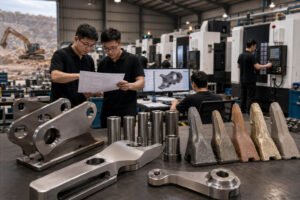
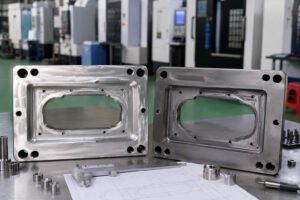
For example, an excavator track-link forming die can consist of a die base, forming inserts, limit blocks, locking screws, guide holes, and other matching components.
Buying these items from one coordinated source can simplify technical communication.
It can also reduce the risk of tolerance mismatch between parts produced by different suppliers.
Forging Production Line and Equipment Selection Knowledge
Some tooling manufacturers focus only on the mold itself.
However, for customers establishing a new forging project, the production equipment can be equally important.
Forging equipment selection must consider:
- Product dimensions
- Material
- Required forming force
- Heating process
- Production volume
- Number of forging stages
- Automation level
- Trimming requirements
A manufacturer with experience in forging line planning can provide more complete technical communication.
This is particularly useful for overseas customers entering a new product category or expanding production capacity.
Instead of treating the die as an isolated item, the supplier can evaluate how the tooling fits the wider forging process.
Communication for Custom and Non-Standard Projects
Most industrial forging dies are not standard catalog products.
They are usually manufactured according to:
- Customer CAD drawings
- Samples
- Existing components
- Reverse-engineered geometry
- New product development requirements
This means communication quality directly affects project quality.
Before placing an order, buyers should ideally provide:
- 2D drawings
- 3D files
- Material grade
- Product weight
- Required production volume
- Forging machine information
- Existing process data
- Heat treatment requirements
- Critical tolerances
- Expected tool life requirements
The more complete the technical information, the more accurately the supplier can evaluate the project.
Frequently Asked Questions
What is a custom forging die?
A custom forging die is a forming tool designed for a specific forged component. Its cavity, structure, dimensions, material, and working surfaces are developed according to the customer’s product and forging process.
Can forging dies be manufactured from customer CAD drawings?
Yes. Custom forging dies can normally be produced from 2D drawings and 3D CAD files. For existing components without complete drawings, reverse engineering may also be used to rebuild the geometry.
Why is metal flow simulation important?
Metal flow simulation helps engineers evaluate how material fills the die cavity during forging. It can reveal potential underfill, folding, stress concentration, excessive flash, or difficult forming areas before physical tooling trials.
Which materials are commonly used for die inserts?
Material selection depends on the application. Cr12MoV, SKD11, P20, 45# steel, and other tool or alloy steels may be used depending on wear, impact, temperature, and structural requirements.
How accurate can custom die components be machined?
Accuracy depends on part size and function. Selected precision components can require tolerances around ±0.005 mm, while larger structural tooling may use different specifications based on functional requirements.
Can a manufacturer supply complete forging tooling assemblies?
Yes. A full-service manufacturer may supply die bases, inserts, guide components, limit blocks, fastening structures, and other custom components as an assembled tooling solution.
Conclusion
Choosing a custom forging die manufacturer should be based on much more than machine quantity or quotation price. Engineering experience, forging knowledge, simulation capability, equipment coverage, material expertise, precision machining, and the ability to produce complete custom tooling all affect the final result.
For B2B buyers, the most valuable supplier is often the one that can understand both the drawing and the production process behind it.
Send your 2D/3D drawings, forging material, and equipment information to Liangde’s engineering team for a technical evaluation and custom tooling quotation.