For precision stamping die inserts, both SKD11 and Cr12MoV are widely used high-carbon, high-chromium tool steels. They offer strong hardness and wear resistance after heat treatment, making them suitable for many automotive sheet-metal dies, forming inserts, limit blocks, and cutting components. However, material grade alone does not determine performance. Heat treatment, machining accuracy, surface finish, insert geometry, and working conditions are equally important.
For overseas B2B buyers, choosing between the two materials should therefore be an engineering decision rather than a purchasing decision based only on price.
Stamping Die Inserts: Why Material Selection Matters
A stamping die insert is usually one of the most heavily loaded components in a die assembly.
Depending on its function, the insert may experience:
- Repeated compressive load
- Sliding contact
- Impact
- Abrasive wear
- Local stress concentration
- High cycle counts
- Repeated assembly and maintenance
This means the insert material must maintain dimensional stability while resisting wear.
For automotive stamping applications, insert replacement can cause downtime. If an insert wears unevenly or loses its working geometry too quickly, it can influence the final stamped panel or structural part.
For this reason, buyers should evaluate material together with heat treatment and machining capability.
SKD11 and Cr12MoV: Basic Comparison
SKD11 is a Japanese JIS designation commonly used for cold-work die steel.
Cr12MoV is a widely used chromium-molybdenum-vanadium cold-work tool steel designation in China.
They belong to a similar family of high-carbon, high-chromium tool steels, but their exact chemical composition and processing standards are not identical.
In practical tooling procurement, both can be used for many similar applications when properly selected and processed.
Material Comparison Table
| Factor | SKD11 | Cr12MoV |
|---|---|---|
| Material category | Cold-work tool steel | Cold-work tool steel |
| Typical use | Precision dies, inserts, punches | Dies, inserts, wear parts |
| Wear resistance | High | High |
| Heat-treatment hardness | High | High |
| Machinability before hardening | Good with proper tooling | Good with proper tooling |
| Grinding after heat treatment | Common | Common |
| Dimensional stability | Good | Good when properly processed |
| Typical sourcing consideration | International recognition | Cost-effective industrial availability |
The final decision should always be based on the customer’s drawing and actual tooling conditions.
Hardness for Precision Die Components
Hardness is one of the most visible specifications on a tooling drawing, but it should not be considered independently.
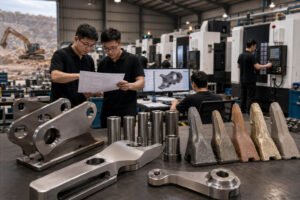
For selected stamping die limit blocks produced from Cr12MoV or SKD11, the heat-treated hardness may reach approximately HRC 56–60 according to the component requirement.
Higher hardness can improve wear resistance, but it can also increase brittleness if the heat treatment process is not suitable for the specific geometry.
Thin sections, sharp corners, holes, and complex transitions can respond differently during heat treatment.
Therefore, a professional manufacturer should consider:
- Part geometry
- Heat-treatment allowance
- Machining sequence
- Final grinding requirement
- Stress relief
- Hardness uniformity
The objective is not simply to reach the highest hardness possible.
The objective is to achieve suitable hardness while maintaining stable dimensions and reliable service performance.
Wear Resistance in Automotive Stamping Dies
Wear resistance matters because die surfaces repeatedly contact sheet metal during production.
In automotive stamping dies, inserts may be used for:
- Forming
- Trimming
- Limiting movement
- Supporting slide mechanisms
- Local cavity replacement
- High-wear working areas
A replaceable insert offers an important maintenance advantage.
Instead of rebuilding an entire die, the maintenance team can replace or rework the worn insert.
This is one reason modular die structures are widely used.
SKD11 and Cr12MoV can both provide good wear resistance for many cold-work applications when heat treated correctly.
However, the actual wear rate also depends on:
- Sheet material
- Sheet thickness
- Lubrication
- Forming pressure
- Contact geometry
- Surface finish
- Tool alignment
A premium steel grade cannot compensate for poor die alignment or incorrect working geometry.
Machining Accuracy Matters as Much as Material
A common mistake is focusing entirely on steel grade while overlooking machining.
Precision inserts often contain:
- Locating holes
- Screw holes
- Dowel holes
- Complex cavities
- Matching surfaces
- Sliding surfaces
- Reference datums
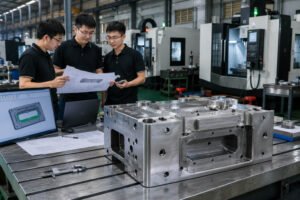
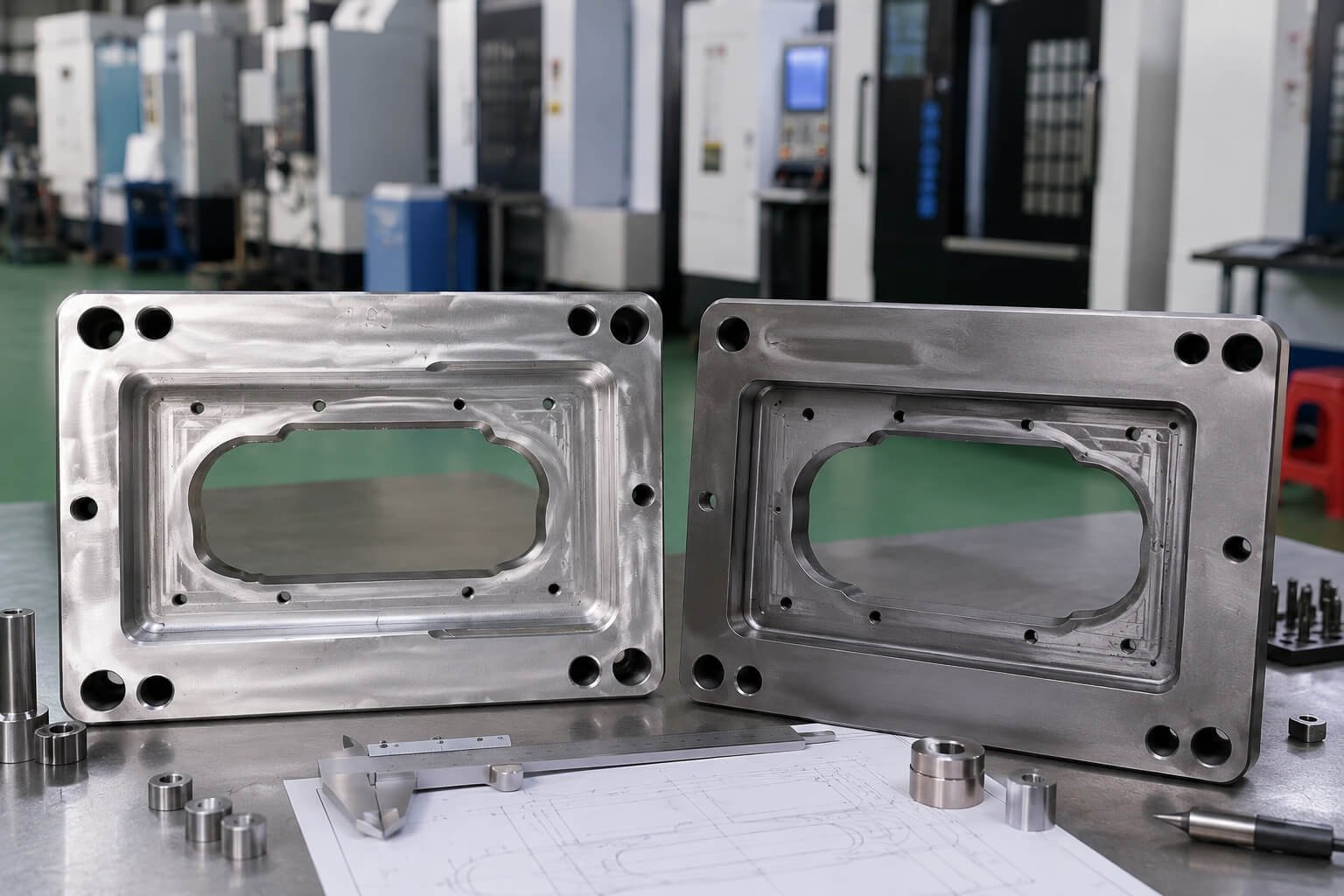
For selected precision die components, machining tolerances may reach around ±0.005 mm, with surface roughness requirements such as Ra 0.8.
Achieving this level usually requires a controlled process.
A typical process may include:
- CNC rough machining
- Semi-finishing
- Heat treatment
- Finish machining
- Precision grinding
- Hole finishing
- Deburring
- Part marking
- Final inspection
The sequence may change depending on the design.
For B2B buyers, the key point is that the finished insert should be inspected according to functional dimensions, not simply measured externally.
CNC Milling, Grinding and Wire EDM
Different features require different machining methods.
CNC Milling
CNC milling is commonly used for:
- Cavity machining
- Contours
- Pockets
- Mounting surfaces
- Drilled holes
- Tapped holes
Precision Grinding
Grinding is particularly useful when high dimensional accuracy and low surface roughness are required after heat treatment.
Wire EDM
Wire EDM is suitable for precision profiles and features that are difficult to produce efficiently with conventional milling.
A tooling manufacturer with multiple processes in-house can choose the most suitable method for each feature.
Liangde’s machining capability includes CNC machining centers, vertical lathes, CNC lathes, gantry machining centers, large horizontal machining centers, milling and drilling equipment, and Wire EDM machines.
This allows different die components to be processed according to their actual geometry.
Typical Applications of SKD11 / Cr12MoV Inserts
Based on current product capability, these materials can be used for several customized tooling components.
Stamping Die Forming Inserts
These are used to shape automotive sheet metal components, including body structural parts and other stamped components.
Stamping Die Inserts
Replaceable inserts can form local working areas inside the main die structure.
Limit Blocks
Limit blocks control the travel position of wedges or sliders and help prevent overtravel.
Track Link Forming Die Inserts
High-hardness inserts can also be used in forming tooling for excavator track-link components.
These applications demonstrate why tool steel selection must correspond to both wear and structural requirements.
SKD11 or Cr12MoV: Which Should a Buyer Choose?
There is no universal answer.
SKD11 may be preferred when:
- The customer’s drawing already specifies JIS SKD11
- The tooling program follows a Japanese material standard
- International material consistency is a key sourcing requirement
- Existing tools already use SKD11
Cr12MoV may be suitable when:
- The customer’s engineering specification allows it
- Local material sourcing is preferred
- The application matches its mechanical and wear characteristics
- Cost optimization is important without compromising functional requirements
A responsible manufacturer should never replace one material with another without customer approval.
What Overseas Buyers Should Put on the RFQ
A detailed RFQ reduces unnecessary technical questions.
For custom stamping die inserts, include:
- 2D drawing
- STEP / IGES / Parasolid file
- Material grade
- Heat-treatment hardness
- Surface treatment
- Critical tolerance
- Surface roughness
- Quantity
- Left/right part identification
- Required inspection report
- Application
For repeat parts, providing the existing part number also helps avoid confusion.
Some tooling components are produced as matched L/R sets. These should be clearly marked throughout manufacturing and inspection.
Quality Control Before Shipment
Before shipment, custom tooling components should be checked according to the approved drawing.
Typical inspection points include:
- Overall dimensions
- Cavity geometry
- Hole diameter
- Hole position
- Parallelism
- Flatness
- Surface finish
- Hardness
- Part identification
Critical dimensions should receive greater attention than non-functional surfaces.
For complex projects, buyers may also request inspection records according to agreed requirements.
This type of documentation makes incoming inspection easier, especially for international supply chains.
Frequently Asked Questions
Is SKD11 better than Cr12MoV for stamping die inserts?
Not in every application. Both materials can perform well. The better choice depends on drawing requirements, working conditions, heat treatment, wear level, dimensional stability, and the customer’s material standard.
What hardness is commonly used for SKD11 die components?
Selected cold-work tooling components may be heat treated to around HRC 56–60. The exact hardness should be determined according to the specific insert function, geometry, and required toughness.
Why are stamping die inserts replaceable?
Replaceable inserts allow high-wear areas to be serviced without replacing the entire die. This reduces maintenance cost, simplifies repairs, and can significantly reduce production downtime.
Can SKD11 inserts be precision ground after heat treatment?
Yes. Precision grinding is commonly used after heat treatment to achieve accurate dimensions, flat surfaces, and specified surface finishes on critical working and locating areas.
Can custom inserts be produced from 3D drawings?
Yes. Custom inserts can be manufactured from customer 2D and 3D files. Reverse engineering may also be possible when physical samples are available but complete design data is missing.
What tolerance can a custom stamping die insert achieve?
Tolerance depends on geometry and size. Certain precision tooling components can be manufactured to approximately ±0.005 mm on specific critical dimensions when the drawing and process require it.
Conclusion
Choosing between SKD11 and Cr12MoV for stamping die inserts requires more than comparing material names. Heat treatment, CNC accuracy, grinding, surface finish, geometry, and actual stamping conditions all influence service performance.
For overseas buyers, the safest approach is to specify the required material standard and critical dimensions clearly, then work with a manufacturer capable of machining, heat treatment coordination, precision finishing, and inspection.
Send Liangde your CAD drawings, material requirement, hardness specification, and quantity for a customized die insert manufacturing review and quotation.